Other Publications
Duda, M.D. & Beppler, T. (in press). Hunting, shooting, fishing, and wildlife watching participation by the numbers: Making sense of all those figures that pass by your screen. Harrisonburg, VA.
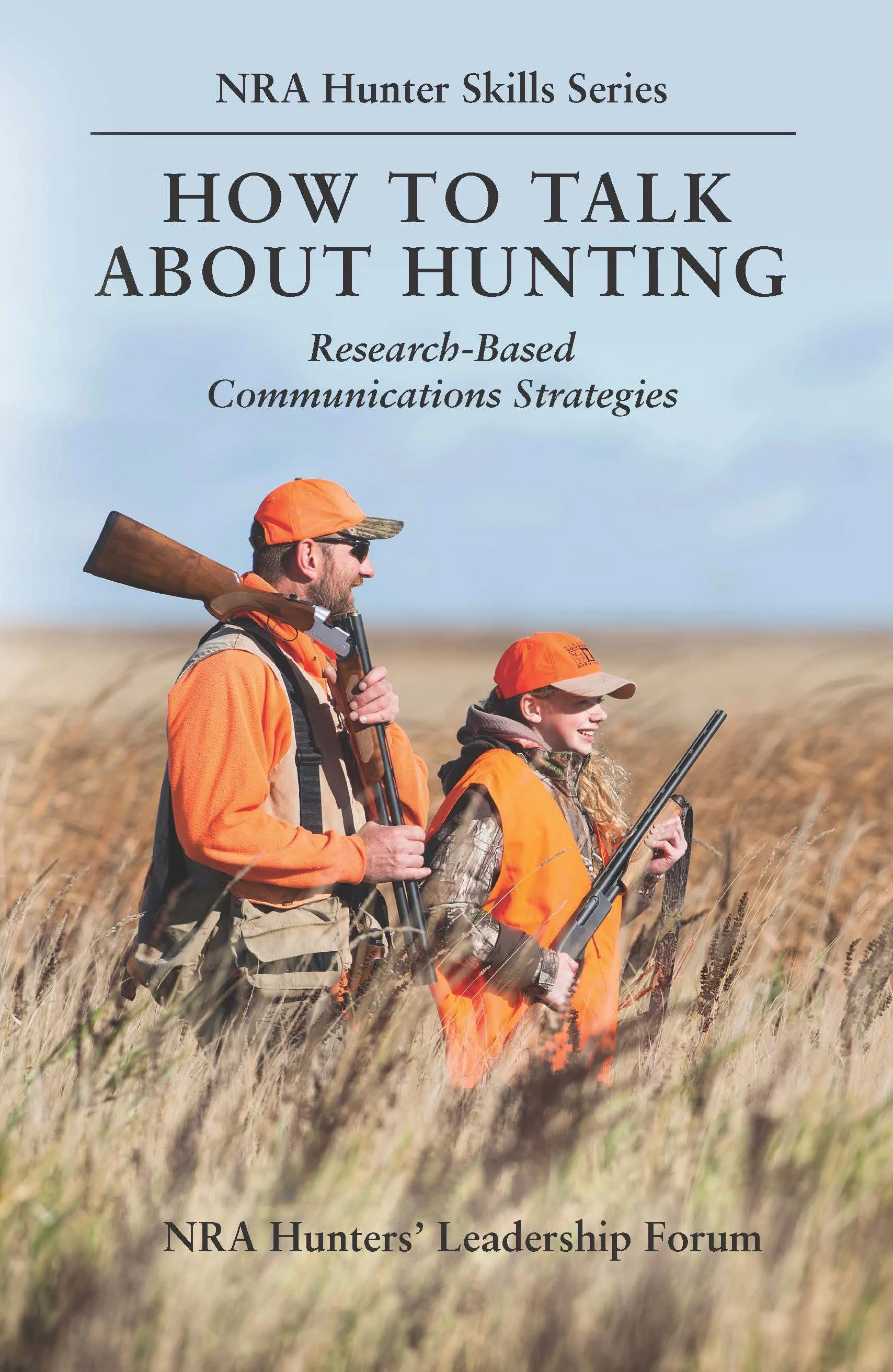
Duda, M.D. & Jones, M.F. (2023). How to talk about hunting: Research-based communications strategies. Hunters’ Leadership Forum.
Duda, M.D. (November 2023). Understanding survey research in fish and wildlife management [Presentation]. Pennsylvania Game Commission.
Duda, M.D. (September 2023). New study sheds light on women’s participation in hunting and shooting. American Hunter Magazine. pp. 22-23.
Duda, M.D. (2023, January 9). New study touts impact of hunting and shooting access on national R3 movement. Hunters’ Leadership Forum.
Duda, M.D., Beppler, T., Organ, J., & Austen, D. (2022). The precarious position of wildlife conservation funding in the United States. The Human Dimensions of Wildlife, Volume 27, Issue 2, pp. 164-172.
Beppler, T. & Duda, M.D. (2022). Conservation words that work: Determining how to engage the American public through the language of conservation. Aquatics Magazine, Volume 44, Number 3, pp. 15-18.
Duda, M.D. (August 2022). Planning for the future of conservation law enforcement in the United States [Presentation]. Presented at the National Conservation Training Center.
Duda, M.D. (February 2022). We are dealing with something that lies pretty deep: The value of white-tailed deer to Americans [Presentation]. Southeast Deer Study Group 45th Annual Meeting.
Duda, M.D. (October 2021). The outdoors are better together…especially when we all pay our fair share! [Presentation]. Southeast Association of Fish and Wildlife Agencies Plenary Session.
Duda, M.D. (April 2021). How to talk about hunting, Parts 1-3 [Presentation]. Webinar series with the Council to Advance Hunting and the Shooting Sports.
Duda, M.D. (December 2020). Wildlife conservation funding in America [Presentation]. 17th Annual NASC Sportsman-Legislator Summit Keynote Speech.
Duda, M.D. (2020, May 1). How will America continue to pay for wildlife conservation? Hunters’ Leadership Forum.
Duda, M.D. (2019, October 6). Study cites support of hunting, fishing, shooting, trapping. Hunters’ Leadership Forum.
Duda, M.D., Beppler, T., & Organ, J. (2017). The growth of sport shooting participation—what does this trend mean for conservation revenue? The Wildlife Professional, Volume 11, Issue 2, pp. 38-40.
Duda, M.D. (2017). A biophilic life: Stephen R. Kellert 1943-2016. Connecticut Wildlife, Volume 37, Number 6, pp. 8-10.
Duda, M.D. (2017, October 11). Study touts positive attitudes toward wildlife officers. Hunters’ Leadership Forum.
Duda, M.D. (2017, April 25). Hunters’ role in national wildlife refuges. Hunters’ Leadership Forum.
Duda, M.D. (2017, April 5). Number of hunters who hunt mostly for the meat still grows. Hunters’ Leadership Forum.
Duda, M.D. & Beppler, T. (2017, January 17). The dirty dozen threats to hunting: 21st century implications for recruitment, retention, and reactivation. Hunters’ Leadership Forum.
Duda, M.D., Jones, M.F., & Beppler, T. (2016, September 13). Hunters’ contributions to U.S. wildlife conservation. Hunters’ Leadership Forum.
Duda, M.D. & Criscione, A. (2014, June 11). Understanding hunting today. Center for Humans & Nature.
Hansen, P.W., Sparrowe, R., & Duda, M.D. (2015). The elements of success in fish and wildlife management: Looking back at the successes and failures of wildlife conservation to guide the profession over the next 100 years. Transactions of the 80th North American Wildlife and Natural Resources Conference. Wildlife Management Institute.
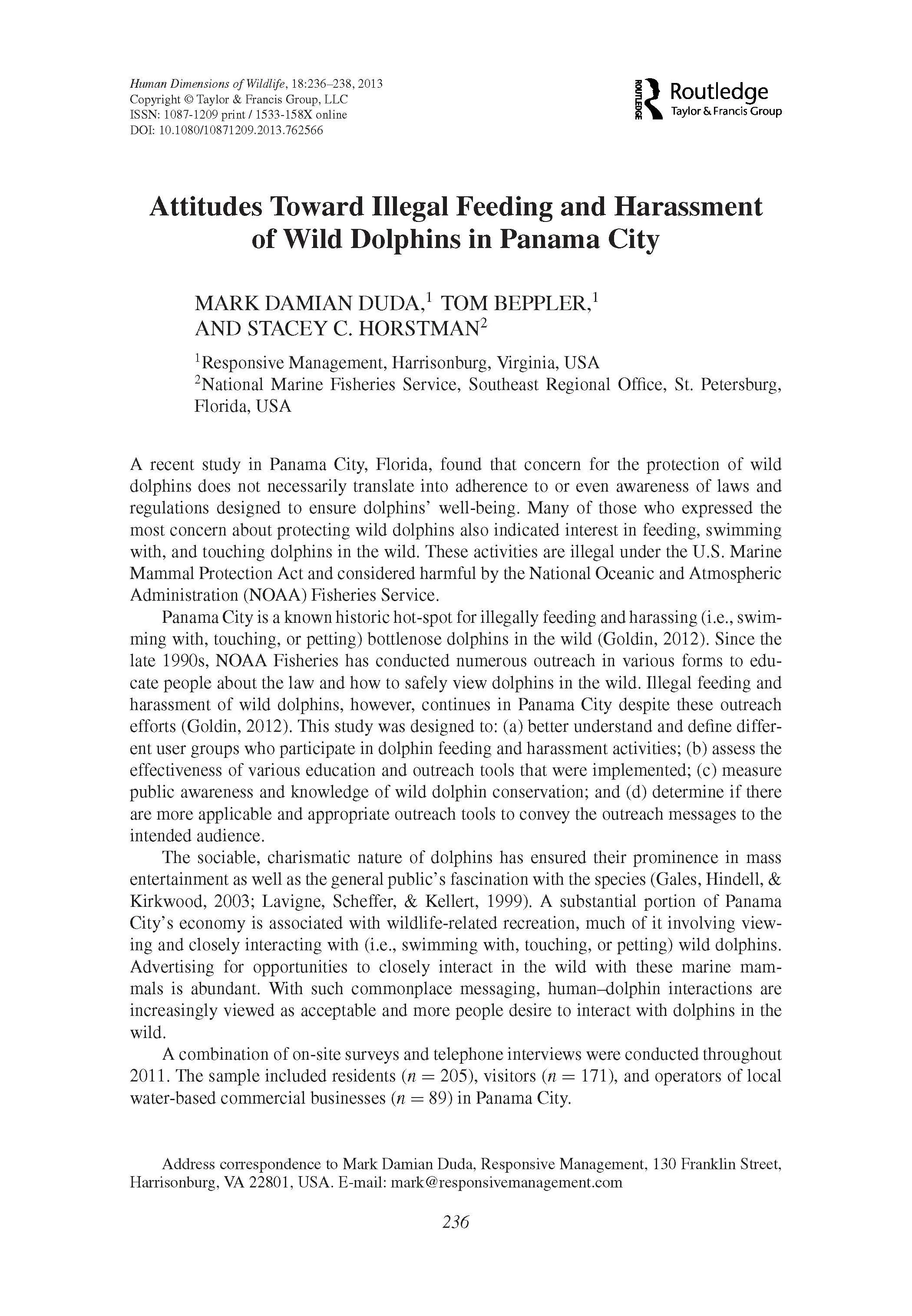
Duda, M.D., Beppler, T., & Horstman, S. (2013). Attitudes toward illegal feeding and harassment of wild dolphins in Panama City. Human Dimensions of Wildlife, Volume 18, Issue 3, pp. 236-238.
Duda, M.D. & Ritchie, A. (2013). Communicating climate change to hunters and anglers: Sportsmen's attitudes toward global warming 2006-2013. Transactions of the 78th North American Wildlife and Natural Resources Conference. Wildlife Management Institute.
Duda, M.D. & Southwick, R. (2012). On the fence about fishing: A study of why anglers do and don’t fish and what will get them on the water (Funded by Multistate Conservation Grant VA M-24-R awarded by the U.S. Fish and Wildlife Service and Association of Fish and Wildlife Agencies). American Sportfishing Association.
Duda, M.D. & Ritchie, A. (July/August 2012). Responsive Management helps manage humans. Turkey Country, p. 36.
Duda, M.D., Jones, M.F., & Criscione, A. (2010). The sportsman’s voice: Hunting and fishing in America. Venture Publishing.
Duda, M.D. & Nobile, J. (2010). The fallacy of online surveys: No data are better than bad data. Human Dimensions of Wildlife, Volume 15, Issue 1, pp. 55-64.
Duda, M.D., Jones, M.F., & Criscione, A. (2009). Public awareness and credibility of fish and wildlife agencies in the northeastern United States. Human Dimensions of Wildlife, Volume 14, Issue 2, pp. 142-144.
Ryan, C.W., Edwards, J.W., & Duda, M.D. (2009). West Virginia residents’ attitudes and opinions toward American black bear hunting. Ursus, Volume 20, Issue 2, pp. 131-142.
Duda, M.D., Jones, M.F., Criscione, A., & Ritchie, A. (2009). The importance of hunting and the shooting sports to state, national and global economies. Proceedings of the World Symposium on the Ecologic and Economic Benefit of Hunting. World Forum on the Future of Sport Shooting Activities, pp. 276-293.
Inkley, D.B., Staudt, A.C., & Duda, M.D. (2009). Imagining the future: Humans, wildlife, and global climate change. Wildlife and Society: The Science of Human Dimensions, pp. 57–72. Manfredo, M. J., Vaske, J. J., Brown, P. J., Decker, D. J., & Duke, E. A., Eds. Island Press.
Duda, M.D. & Jones, M.F. (2009). Public opinion on and attitudes toward hunting. Transactions of the 73rd North American Wildlife and Natural Resources Conference, pp. 180-198. Wildlife Management Institute.
Duda, M.D. (2006). Managing negative human-wildlife situations. Transactions of the 71st North American Wildlife and Natural Resources Conference, pp. 59-66. Wildlife Management Institute.
Duda, M.D., DeMichele, P., Jones, M.F., Criscione, A., & Bissell, S. (2005). The role of the private sector and landowners’ attitudes toward fish and wildlife management and wildlife-related recreation. Transactions of the 70th North American Wildlife and Natural Resources Conference, pp. 77-87. Wildlife Management Institute.
Duda, M.D., Zurawski, C., Bales, C., De Michele, P., Harrison, B., Hayes, G., & Self, R. (2004). Human dimensions research and programmatic planning for the South Carolina Department of Natural Resources Freshwater Fisheries Section: A case history. Proceedings of Southeastern Fish and Wildlife Conference.
Duda, M.D. (October 2004). The sportsmen's vote. North American Hunter, p. 48.
Duda, M.D. (September 2004). Attitudes toward high-fenced hunting. North American Hunter, p. 42.
Duda, M.D. (August 2004). The “state” of hunting participation. North American Hunter,
p. 38.
Duda, M.D. (July/August/September 2004). High achievers: NAFC members leave other anglers in their wake. North American Hunter, p. 22.
Duda, M.D. (June/July 2004). Hunter “fear” factor. North American Hunter,
p. 34.
Duda, M.D. (May/June 2004). Degrees of satisfaction: Angler satisfaction varies by species pursued. North American Fisherman, p. 24.
Duda, M.D. (April/May 2004). Attitudes toward CWD revealed. North American Hunter, p. 30.
Duda, M.D. (April 2004). Perennial favorites: Fishermen pursue panfish at all stages of their careers. North American Fisherman, p. 26.
Duda, M.D. (March 2004). Drive times: How far are anglers willing to travel? North American Fisherman, p. 28.
Duda, M.D. (February/March 2004). Turkey hunting trends. North American Hunter, p. 28.
Duda, M.D. (February 2004). Kids and fishing: Youths support fishing, but few hear about the sport. North American Fisherman, p. 28.
Duda, M.D. (December/January 2003/2004). Compelled to fish: Research reveals angler motives are constantly changing. North American Fisherman, p. 29.
Duda, M.D. (December/January 2003/2004). Kids’ attitudes toward hunting. North American Hunter, p. 24.
Duda, M.D. (November 2003). Chronic wasting disease reader survey. North American Hunter, p. 34.
Duda, M.D. (October/November 2003). Anglers who hunt: Few differences separate anglers who hunt from those who don’t. North American Fisherman, p. 14.
Duda, M.D. (October 2003). Pass on the tradition. North American Hunter, p. 40.
Duda, M.D. (July/August/September 2003). League of their own: Catfish anglers, like their quarry, stand apart from their peers. North American Fisherman, p. 20.
Duda, M.D. (August 2003). Seven truths about firearms. North American Hunter, p. 28.
Duda, M.D. (June/July 2003). Better safe than sorry. North American Hunter, p. 36.
Duda, M.D. (May/June 2003). Effective messages: Choose the right lesson when teaching kids to fish. North American Fisherman, p. 26.
Duda, M.D. (April/May 2003). Hunters and treestand safety. North American Hunter, p. 30.
Duda, M.D. (April 2003). Committed to conservation: Fisherman are ardent conservationists. North American Fisherman.
Duda, M.D. (March 2003). Cause and effect: Fishing license fee increases trigger sales declines. North American Fisherman, p. 24.
Duda, M.D. (February 2003). Hunters help fuel the economy. North American Hunter, p. 26.
Duda, M.D. (February 2003). Getting to water: Difficulties with access reduced angler numbers. North American Fisherman, p. 26.
Duda, M.D. (December/January 2002/2003). And the survey says… North American Hunter, p. 28.
Duda, M.D. (December/January 2002/2003). Evolution of an angler: Most fishermen go through predictable stages of development. North American Fisherman, p. 20.
Duda, M.D. & Bissell, S. (2002). Marketing wildlife-viewing experiences. In M.J. Manfredo (Ed.), Wildlife viewing: A management handbook (pp. 307–325). Oregon State University Press.
Duda, M.D., De Michele, P., Allen, D., Harrison, B., Nash, V., Hayes, G., & Self, R. (2002). Attitudes of South Carolina youth towards aquatic resources and recreational fishing. Proceedings of Southeastern Fish and Wildlife Conference, pp. 421-433.
Duda, M.D., De Michele, P., Cook, R., Sansom, A., Saldaña, L., Dziekan, K., & Bontempo, D. (2002). Texas Parks and Wildlife for the 21st Century. Proceedings of Southeastern Fish and Wildlife Conference, pp. 434-449.
Duda, M.D. (November 2002). A PFD could save your life. North American Hunter, p. 35.
Duda, M.D. (October/November 2002). The state of sportfishing: national survey reveals angler numbers remain steady. North American Fisherman, p. 20.
Duda, M.D. (October 2002). Public supports hunting. North American Hunter, p. 45.
Duda, M.D. (September 2002). Conserving our wetlands. North American Hunter, p. 43.
Duda, M.D. (August 2002). Got an attitude? North American Hunter, p. 42.
Duda, M.D. (July/August/September 2002). Contaminated catches: How anglers react to consumption advisories. North American Fisherman, p. 20.
Duda, M.D. (June/July 2002). Americans support wetlands. North American Hunter, p. 32.
Duda, M.D. (May/June 2002). Hard habit to break: Anglers know PFDs’ benefits, but few wear them. North American Fisherman, p. 22.
Duda, M.D. (April/May 2002). Public attitudes toward trapping. North American Hunter, p. 32.
Duda, M.D. (April 2002). Communication gap: Anglers are conservation’s unsung heroes. North American Fisherman, p. 20.
Duda, M.D. (March 2002). Bass rule: Coast to coast, black bass are most popular. North American Fisherman, p. 18.
Duda, M.D. (February/March 2002). Youth and hunting. North American Hunter, p. 30.
Duda, M.D. (February 2002). On the rise: After years of decline, angler numbers climb again. North American Fisherman, p. 20.
Duda, M.D. (December/January 2001/2002). Examining participation trends. North American Hunter, p. 28.
Duda, M.D. (December/January 2001/2002). Reaching out: We must introduce children to fishing. North American Fisherman, p. 20.
Duda, M.D., & Brown, K.L. (2001). Texas landowners’ attitudes toward wildlife, conservation and outdoor recreation. Transactions of the 66th North American Wildlife and Natural Resources Conference, pp 1-10. Wildlife Management Institute.
Duda, M.D. (November 2001). Women and hunting. North American Hunter, p. 35.
Duda, M.D. (October/November 2001). Lone star success story: Texas anglers happy with state’s fisheries. North American Fisherman, p. 16.
Duda, M.D. (October 2001). Waterfowl hunters soar with populations. North American Hunter, p. 45.
Duda, M.D. (September 2001). Ready, aim, fire . . . at the target. North American Hunter, p. 39.
Duda, M.D. (August 2001). Interest in elk growing. North American Hunter, p. 37.
Duda, M.D. (July/August/September 2001). Who are we? A look at the many faces of fishing. North American Fisherman, p. 20.
Duda, M.D. (June/July 2001). Bowhunting hits the target. North American Hunter, p. 32.
Duda, M.D. (April/May 2001). Hunter ed: More than safety. North American Hunter, p. 32.
Duda, M.D. (April 2001). Angling the internet: Who’s online and why? North American Fisherman, p. 22.
Duda, M.D. (March 2001). Degrees of dedication: Who fishes the most, and why. North American Fisherman, p. 18.
Duda, M.D. (February/March 2001). VA protects sportsmen's rights. North American Hunter, p. 36.
Duda, M.D. (February 2001). Avid readers: Half of all angers read vertical angling publications. North American Fisherman, p. 18.
Duda, M.D. (December/January 2000/2001). Analyzing hunting trends. North American Hunter, p. 24.
Duda, M.D. (December/January 2000/2001). Too many roads? What anglers think about limiting access to national forests. North American Fisherman, p. 16.
Duda, M.D. (November 2000). Hunting on private land. North American Hunter, p. 38.
Duda, M.D. (October/November 2000). Trying to fly: Interest in fly fishing is high, but few stick with it. North American Fisherman, p. 16.
Duda, M.D. (October 2000). Values dictate Sunday hunting. North American Hunter, p. 46.
Duda, M.D. (September 2000). Meet today’s hunter. North American Hunter, p. 52.
Duda, M.D. (August 2000). Just show me the facts. North American Hunter, p. 46.
Duda, M.D. (July/August/September 2000). Perfect day to die: Most fishing-related drownings occur on calm waters. North American
Fisherman, p. 18.
Duda, M.D. (June/July 2000). To road or not to road. North American Hunter, p. 38.
Duda, M.D. (May/June 2000). Size matters: For many anglers, biggest is best. North American Fisherman, p. 22.
Duda, M.D. (April/May 2000). Big game popularity soars. North American Hunter, p. 38.
Duda, M.D. (April 2000). Who's tuning in? Even non-anglers enjoy televised fishing. North American Fisherman, p. 20.
Duda, M.D. (March 2000). Dollars and sense: Anglers will spend more to benefit the resource. North American Fisherman, p. 20.
Duda, M.D. (February/March 2000). Wildlife management's future. North American Hunter, p. 26.
Duda, M.D. (February 2000). Public approval: PETA’s anti-fishing campaign is still failing miserably. North American Fisherman, p. 18.
Duda, M.D. (December/January 1999/2000). Attitudes toward wildlife. North American Hunter, p. 22.
Duda, M.D. (December/January 1999/2000). In the public eye: Angling’s messages good, but not strong enough. North American Fisherman, p. 18.
Duda, M.D. (1999). West Virginia wildlife viewing guide. Falcon Press.
Duda, M.D. (November 1999). Public attitudes toward trapping. North American Hunter, p. 38.
Duda, M.D. (October/November 1999). Reaching out: Sportfishing must lure more non-anglers. North American Fisherman, p. 20.
Duda, M.D. (October1999). Just how much is enough? North American Hunter, p. 38.
Duda, M.D. (September 1999). Guess who is paying the bill? North American Hunter, p. 38.
Duda, M.D. (August 1999). High-tech tools for teachers. North American Hunter, p. 46.
Duda, M.D. (July/August/September 1999). Common ground: Everyone agrees—clean water matters. North American Fisherman, p. 20.
Duda, M.D. (May/June 1999). Age and angling: Senior angling numbers are surprisingly low. North American Fisherman, p. 22.
Duda, M.D. (April 1999). Changing attitudes: Fishing for food no longer primary motivation. North American Fisherman, p. 24.
Duda, M.D., Bissell, S., & Young, K. (1998). Wildlife and the American mind: Public opinion on and attitudes toward fish and wildlife management. Harrisonburg, VA.
Duda, M.D., Bissell, S., & Young, K. (1998). Recent studies on hunting and fishing participation in the United States. The Human Dimensions of Wildlife, Volume 3, Issue 1, pp. 75-80.
Duda, M.D. & Young, K. (1998). American attitudes toward scientific wildlife management and human use of fish and wildlife: Implications for effective public relations and communications strategies. Transactions of the 63rd North American Wildlife and Natural Resources Conference, pp. 589-603. Wildlife Management Institute.
Duda, M.D., Young, K., & Bissell, S. (1998). Partnerships in conservation: Using human dimensions to strengthen relationships between fish and wildlife agencies and their constituents. Transactions of the 63rd North American Wildlife and Natural Resources Conference, pp. 268-277. Wildlife Management Institute.
Manfredo, M.J., Decker, D.J., & Duda, M.D. (1998). What is the future for human dimensions of wildlife? Transactions of the 63rd North American Wildlife and Natural Resources Conference, pp. 278-292. Wildlife Management Institute.
Duda, M.D. (October 1998). It's here: The strategic plan for the National Outreach and Communication Program. Fishing Tackle Trade News, p. 10.
Duda, M.D. (September 1998). Super cops: By and large, anglers have nothing but praise for fish and wildlife conservation officers. Fishing Tackle Trade News, p. 13.
Duda, M.D. (August 1998). Fun and games: The life of an information gatherer isn't always a blur of facts and figures. Fishing Tackle Trade News, p. 11.
Duda, M.D. (July/August 1998). Turning the tide: Groups join forces to promote fishing. North American Fisherman, p. 22.
Duda, M.D. (July 1998). The older angler: Fishing participation is down among seniors, but that doesn’t mean we can’t bring those numbers up. Fishing Tackle Trade News, p. 15.
Duda, M.D. (June 1998). Statistics don't tell the whole story: Reading between the lines can reveal interesting and helpful trends. Fishing Tackle Trade News, p. 13.
Duda, M.D. (May/ June 1998). Competitive spirit: Anglers’ opinions on tournament fishing. North American Fisherman, p. 20.
Duda, M.D. (May 1998). Concerns for a cause: The sport fishing and boating partnership council is out to shake up the public’s views on recreational fishing and boating—and it needs our help. Fishing Tackle Trade News, p. 15.
Duda, M.D. (April 1998). Conservation first: Anglers put water quality, habitat before recreation. North American Fisherman, p. 18.
Duda, M.D. (April 1998). Water, water everywhere: Not surprisingly, anglers consider the cool, clear stuff to be America’s most precious natural resource—why should you know this? Fishing Tackle Trade News, p. 12.
Duda, M.D. (March 1998). Too much red tape? Exploring attitudes toward fishing regulations. North American Fisherman, p. 26.
Duda, M.D. (February 1998). Where do anglers shop? An ASA market survey reveals much about freshwater fishermen and their preferred places of purchase. Fishing Tackle Trade News, p. 12.
Duda, M.D. (February 1998). Who are we, anyway? A closer look at American anglers. North American Fisherman, p. 18.
Duda, M.D. (January 1998). Debunking the myth: Marketing, Part II: Planning and perseverance are key ingredients in the recipe for a successful business. Fishing Tackle Trade News, p. 15.
Duda, M.D. & Young, K. (1997). The effects of mandatory basic hunter education and advanced hunter training on hunter recruitment, satisfaction and retention. Fish and Wildlife Reference Service Newsletter No. 113. U.S. Fish and Wildlife Service.
Duda, M.D. (December/January 1997/1998). Big spenders: Anglers give economy $38 billion boost. North American Fisherman, p. 24.
Duda, M.D. (December 1997). Debunking the myth: Marketing, Part I: Often regarded as little more than snake oil, this misunderstood form of management is actually just what the doctor ordered. Fishing Tackle Trade News, p. 10.
Duda, M.D. (November/December 1997). Safe smarts. North American Hunter, p. 46.
Duda, M.D. (November 1997). Fishing tournaments: A look at participation in and attitudes toward these increasingly popular events. Fishing Tackle Trade News, p. 13.
Duda, M.D. (October 1997). Where the anglers are: A look at the ebb and flow of freshwater fishing participation. Fishing Tackle Trade News, p. 10.
Duda, M.D. (September/October 1997). Forget the stereotype: Single moms raise fishing kids. North American Fisherman, p. 24.
Duda, M.D. (September 1997). An attitude about hunting. North American Hunter, p. 38.
Duda, M.D. (September 1997). Children’s fishing participation: Just how important is it for them to get started early? Fishing Tackle Trade News, p. 7.
Duda, M.D. (August 1997). The myth of the single-parent household. Fishing Tackle Trade News, p. 13.
Duda, M.D. (August 1997). This tax is ok with hunters. North American Hunter, p. 46.
Duda, M.D. (July/August 1997). Kids and fishing: Most anglers start young. North American Fisherman, p. 28.
Duda, M.D. (July 1997). And the survey said …?! Early numbers are in for the 1996 National Survey of Fishing, Hunting and Wildlife-Associated Recreation. Fishing Tackle Trade News, p. 11.
Duda, M.D. (June 1997). Keeping anglers on the hook: Reversing the decline in angling will take careful planning and execution. Fishing Tackle Trade News, p. 21.
Duda, M.D. (May/June/July 1997). Survey says . . . archery's sweeping the nation. North American Hunter, p. 91.
Duda, M.D. (May/June/July 1997). Does hunting pass the test? North American Hunter, p. 34.
Duda, M.D. (May/June 1997). Animal rights: Survey strips away falsehoods. North American Fisherman, p. 28.
Duda, M.D. (May 1997). Hey, big spender! Who are they? Where are they? Fishing Tackle Trade News, p. 15.
Duda, M.D. (April 1997). Who pays for sportfishing? North American Fisherman, p. 30.
Duda, M.D. (April 1997). Are fishermen really conservationists? The answer might surprise you—at least in Pennsylvania. Fishing Tackle Trade News, p. 11.
Duda, M.D. (March/April 1997). Why do we hunt? North American Hunter, p. 30.
Duda, M.D. (March 1997). Marketing and recreational fishing promotion. Proceedings of Southeastern Fish and Wildlife Conference, pp. 20-31.
Duda, M.D. (March 1997). Satisfaction (almost) guaranteed: Most anglers rank fishing experiences highly. North American Fisherman, p. 32.
Duda, M.D. (March 1997). Meet today's freshwater anglers: A glimpse at their demographics reveals valuable information for dealers, jobbers and manufacturers. Fishing Tackle Trade News, p. 12.
Duda, M.D. (February 1997). Fishing’s gender factor. North American Fisherman, p. 26.
Duda, M.D. (February 1997). Market research methods: A primer: These tools can be invaluable in assessing the needs of your customers. Fishing Tackle Trade News, p. 11.
Duda, M.D. (January/February 1997). Hunting: The human element. North American Hunter, p. 52.
Duda, M.D. (January 1997). Anglers: New target for animal-rights groups. Fishing Tackle Trade News, p. 12.
Duda, M.D., Young, K., & Bissell, S. (1996). Factors related to hunting and fishing participation in the United States. Transactions of the 61st North American Wildlife and Natural Resources Conference, pp. 324-337. Wildlife Management Institute.
Duda, M.D. & Case, D.J. (1996). Illinois fur hunting and trapping project: A case study in facing reality. Transactions of the 61st North American Wildlife and Natural Resources Conference, pp. 150-154. Wildlife Management Institute.
Duda, M.D. & Young, K. (1996). Sustaining wildlife values in the public sector: An overview of state and federal management issues. Transactions of the 61st North American Wildlife and Natural Resources Conference, pp. 280-283. Wildlife Management Institute.
Duda, M.D. (December 1996). Why is participation in fishing declining? It’s a complex issue with no sweeping solution. Fishing Tackle Trade News, p. 11.
Duda, M.D. (November 1996). How do anglers view fishing regulations? Fishing Tackle Trade News, p. 13.
Duda, M.D. (October 1996). Fly fishing participation: A new survey offers data on the who, when, why, and where. Fishing Tackle Trade News, p. 12.
Duda, M.D. (September 1996). Anglers strongly support the Federal Aid in Sport Fish and Wildlife Restoration Program. Fishing Tackle Trade News, p. 12.
Duda, M.D. (July 1996). A bad day fishing is still better than a good day at work. Fishing Tackle Trade News, p. 24.
Duda, M.D. (June 1996). Money matters: It sure does, but who is spending it and where? Fishing Tackle Trade News, p. 13.
Duda, M.D. (May 1996). The fisherwoman: Who is she? Fishing Tackle Trade News, p. 13.
Duda, M.D. (April 1996). Public opinion on fishing. Fishing Tackle Trade News, p. 6.
Duda, M.D. (1995). Watching wildlife: Tips, gear and great places for enjoying America’s wild creatures. Falcon Press.
Duda, M.D. (1994). Virginia wildlife viewing guide. Falcon Press.
Duda, M.D. (1994). A study of factors related to hunting and fishing participation in the U.S. Fish and Wildlife Reference Service Newsletter No. 101. U.S. Fish and Wildlife Service.
Duda, M.D. (1992). A new era of conservation information: Finding the right tool for the job. Transactions of the 57th North American Wildlife and Natural Resources Conference. Wildlife Management Institute.
Duda, M.D. (1989). What have you done for wildlife lately? Twenty-three ways a citizen can help Florida’s wildlife. Florida Naturalist (Summer), pp. 9-12.
Duda, M.D. (1989). From awareness to action. Florida Wildlife, Volume 43, Issue 2, p. 45.
Duda, M.D. & Cerulean, S.I. (1989). Floridians’ wildlife-related activates, opinions, knowledge and attitudes toward wildlife. Nongame Wildlife Program Technical Report. Florida Game and Fresh Water Fish Commission.
Duda, M.D., Cerulean, S.I., & Gillan, J.A. (1989). Comprehensive wildlife education planning in Florida: The value of human dimensions research. Transactions of the 54th North American Wildlife and Natural Resources Conference, pp. 455-467. Wildlife Management Institute.
Duda, M.D. & Moody, P. (1988). The 1987-88 Florida Wildlife Magazine reader survey: What our readers told us. Florida Wildlife, Volume 43, Issue 6, pp. 22-25.
Duda, M.D. (1988). The public and raptor conservation in the southeast: An approach to human southeast raptor management. In B.G. Pendleton, M.N. LeFrank, Jr., & B.A. Millsap (Eds.), Proceedings of the Southeast Raptor Management Symposium and Workshop, pp. 121-26.
Duda, M.D. (1988). Floridians’ wildlife education needs. Part 2: Target audiences. Florida Science Teacher, Volume 3, Issue 4, pp. 8-12.
Duda, M.D. (1988). Floridians’ wildlife education needs. Part 1: Key messages. Florida Science Teacher, Volume 3, Issue 3, pp. 15-19.
Duda, M.D. (1987). Our children are the future of wildlife. Florida Wildlife, Volume 41, Issue 2, pp. 40-42.
Duda, M.D. (1987). Public opinion on environmental protection and wildlife conservation. Florida Environmental and Urban Issues, Volume 15, Issue 1, pp. 10-13.
Duda, M.D. (1987). Measuring public opinion and attitudes toward environmental issues: A primer. The Monitor, Volume 7, Issue 3, pp. 3-6.
Duda, M.D. (1987). Floridians and wildlife: Sociological implications for wildlife conservation in Florida. Nongame Wildlife Program Technical Report No. 2. Florida Game and Fresh Water Fish Commission.
Duda, M.D. (1986). Wildlife management: The human element. Florida Wildlife, Volume 40, Issue 5, pp. 14-17.